


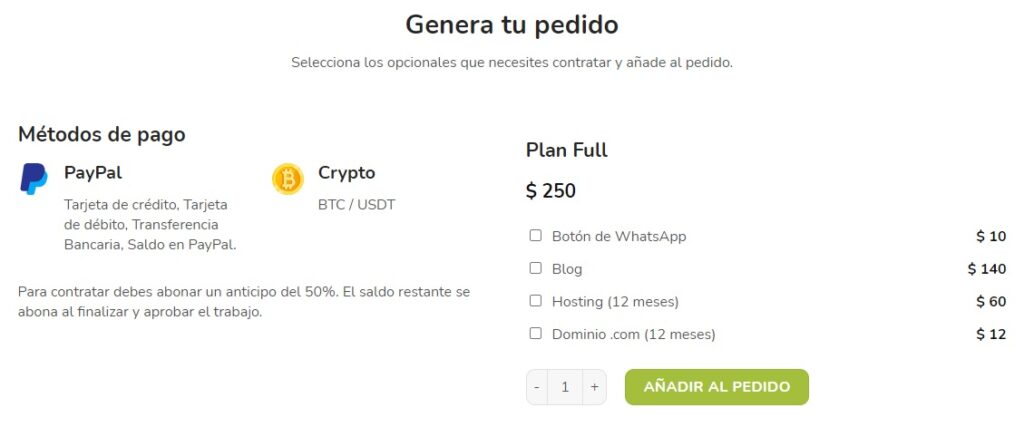
Always attentive to the needs of our clients, at Grupo Vansur we decided to echo the growing digitalization of the economy and take a step forward: we enabled payment for our services with cryptocurrencies, a trend that grew with the pandemic, is here to stay, and -apparently- multiply.
In this way, our agency becomes one of the first of its kind to offer this option and brings us one step closer to one of our goals: to offer our clients a quality experience from the first minute of our commercial relationship; including, of course, the payment experience.
We are interested in testing new technologies that can contribute to the efficient management of companies and, in this specific case, open the doors to selling services or products abroad. Whenever a novelty arises, we decide to learn about it, test it, and –if effective– implement it.
This is what we did with all the services we offer: from the development of online stores and websites, to the configuration of marketing campaigns, CRM or email marketing, among others.
In the case of cryptocurrencies, after successfully implementing it in our own agency, we are now in a position to offer our clients payment gateways that open up the sales experience internationally.
How to make a payment with cryptocurrencies?
From our online store, users will be able to choose to pay for our service packages with bitcoins or USDT -a stablecoin also called Tether- by making the transfer from a wallet (electronic wallet) securely and quickly. Stablecoins, as their name indicates, are stable currencies that follow the quotation of another asset from the traditional economy, such as the dollar.
Financial inclusion is one of the post-pandemic concerns of the global financial sector. And it's no small matter. The restrictions experienced in 2020 demonstrate the importance of having digital options.
According to the Argentine Fintech Chamber, more than 8 million users already have digital wallets to pay in stores, transfer money, or invest. “Managing finances from a cell phone grants a certain digital empowerment,” states the report issued by this entity.
Furthermore, “digital payments help reduce insecurity incidents related to cash handling, increase transparency, and provide users with a shared record of their expenses/finances that can be used to improve their credit profile,” the document adds.
The digital economy –as the connective activity that occurs in digital environments is called– is not a local asset. Its enormous growth is a subject of analysis for international organizations and governments.
In this context, the world of crypto went in a few months from being almost exclusively used by large investors to becoming part of the everyday language and practice of millions of people.
Globally, large corporations already accept cryptocurrencies in exchange for their services. Such is the case of the global chain Starbucks, which has accepted bitcoin since April through the wallet Bakkt. Something similar happens with TravelbyBit, a flight and hotel booking service, or the platform Gyft, dedicated to selling gift cards.
The list is constantly growing.
Some definitions from the crypto world
For those who are just starting out or want to know what the world of crypto is all about, we share some definitions that will help you - or so we hope! - not to get lost in the immensity of existing information on the subject.
What is a cryptocurrency?
A cryptocurrency is a digital asset that uses cryptographic encryption to guarantee its ownership and control the creation of additional units or copies. These currencies do not exist physically: they are stored in a digital wallet.
How is the value of a cryptocurrency set?
The value of cryptocurrencies varies depending on supply and demand.
Blockchain
It is a technology presented by bitcoin, which converts virtual currencies into decentralized entities. It is an electronic ledger, where several blocks of information are stored. These blocks contain the data of all transactions made with a cryptocurrency.
Exchange
Exchange platforms offer different solutions for storing, sending or receiving cryptocurrencies.
Satoshis or SATS
Bitcoin is the leading cryptocurrency and is often the basis for exchanging or “trading” with other currencies (also called “altcoins” because they are considered alternatives to bitcoin). Therefore, the price of other cryptocurrencies is usually expressed in terms of bitcoin.
A Satoshi is the smallest unit of a bitcoin, corresponding to one hundred millionth of a BTC (0.00000001 BTC). A sat is the diminutive for a Satoshi. Thus, it is common to read phrases like: «the price of Litecoin is approaching its all-time high of 2.4 MSats».
Bagholder
Refers to a person who bought and holds cryptocurrencies hoping that the price will rise in the future to be able to take profits.
Shitcoin
An altcoin not as well known as bitcoin, litecoin or ethereum. It may also be one that lost its value over time or one that turned out to be a scam.
More or less, the truth is that virtual currencies constitute a new form of exchange fully applicable to the digital economy.
Have you thought about using any of these options in your company? Leave us a comment and tell us what you think of these new forms of commercial exchange proposed by the digital economy.