
What is a CRM: The Key to Ditching Excel and Boosting Your Commercial Management
 Agustín NastasiaCEO & Founder
Published: · Updated:

Currently, the advanced connection between everyday devices and computer systems makes it possible to access a large amount of information about the behavior and choices of our audiences.
This abundance of data is a great asset for companies when looking for new clients. However, this opportunity can lose meaning if there isn't an automation system that processes and simplifies the data.
Nowadays, the use of Customer Relationship Management programs is increasingly common, which in English is known by the acronym CRM (Customer Relationship Management).
Previously they were only within reach of large companies and, now, they are also accessible and very effective options for SMEs.
Ultimately, these are digital automations that require a very low investment, designed to accompany prospecting and sales circuits, guaranteeing customer satisfaction and well-being throughout the entire process.
CRM comes to show SMEs that, to grow, it is necessary to accept the intervention of technology and automate processes.
What does your company need to grow?
This is a frequent question, whose answer leads us to think about the different stages a productive venture goes through to gain sales volume, acquire notoriety, and leave a positive mark in the memory of consumers or clients.
Generally, the first growth impulse of any traditional company is given by the recommendations from “satisfied” customers”. Nothing better than starting a commercial relationship with the endorsement of someone who has already had a valuable experience.
This exchange has its own characteristics: it occurs gradually and sustainedly. We could say that it happens on a “human scale,” as it takes place outside of screens and digital marketing, and is the result of good actions.
However, the growth achieved by “word-of-mouth” communication, what is known in the jargon as “referrals”, has a significant drawback: the slowness of its process.
It is strategic to know that while a traditional company focuses only on meeting the demand of referrals, other companies in the same sector already have an online presence through Google Adwords campaigns, email marketing, web positioning, participation in webinars, social networks and all kinds of digital exchange that allows them to increase their prospecting channels.
For increase sales volume y leave a positive mark in the memory of audiences, companies need to display their services or products on multiple and simultaneous channels, generating a flow of data from people interested in receiving information.
What usually happens with companies as they sign up for social networks, digital advertising campaigns and other platforms? They cannot respond to the generated expectation.
An excessive accumulation of data, is generated, which leads to congestion in communication between the company and interested parties.
How to approach digital growth without falling into the abyss?
No excel, notebook, whiteboard or agenda can withstand it, if this communication flow is not transformed into the implementation of partially automated circuits. And that, among other things, is what CRM takes care of.
A CRM serves to organize and standardize a company's sales process
- Sales management.
- Prospect management.
- Revenue management.
- Marketing campaign analysis.
- Internal communication.
- Management and resolution of complaints, queries.
In the market, there are dozens of automated systems for managing data flow. All of them have a free version that allows for a global understanding of their operation and, generally, it needs to be configured by an expert.
Among the best known are Hubspot, Zoho, Salesforce y Pipedrive. In our agency, we specialize in the implementation and consulting of the latter two.
What does CRM have that Excel doesn't?
One of the comparative advantages is the logging of inquiries. When someone leaves an information request through a website form, a landing page, or a lead generation form on social media, the CRM automatically enters the inquiry and can, if configured this way, send an automatic welcome and prompt response email or, for example, a company presentation video.
Telephone or Whatsapp requests can also be entered manually, consolidating all customer inquiries or communications in one place.
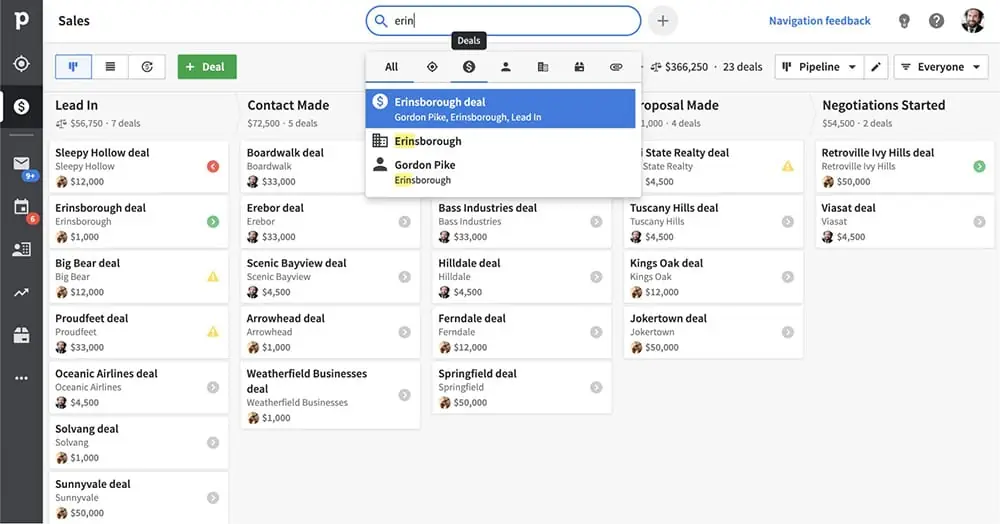
In turn, each of these contacts has its own tracking system with a menu that offers the possibility to send emails, record notes, and schedule tasks, among other functions.
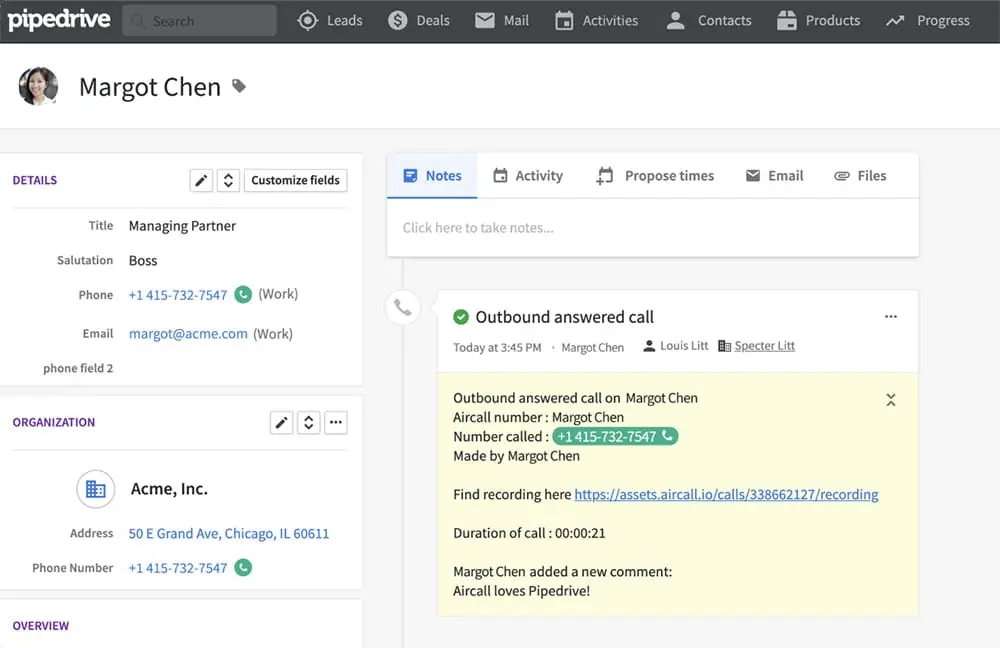
Another option is the configuration of templates that contain answers to frequently asked questions. This way, the sales executive will have speed and maximum neatness when responding to received inquiries.
A CRM allows you to have very precise reports about your sales, what type of products sell the most, from which marketing channel a potential customer entered, and, something very important, to have an organized database that can then be used for Email Marketing campaigns.
In summary, CRM is a necessary tool to monitor the quality of responses in commercial management and consolidate data and optimize processes. If you consider it's time to grow and increase your company's sales volume, we invite you to reflect on the need to automate processes and take your team to the next level.